
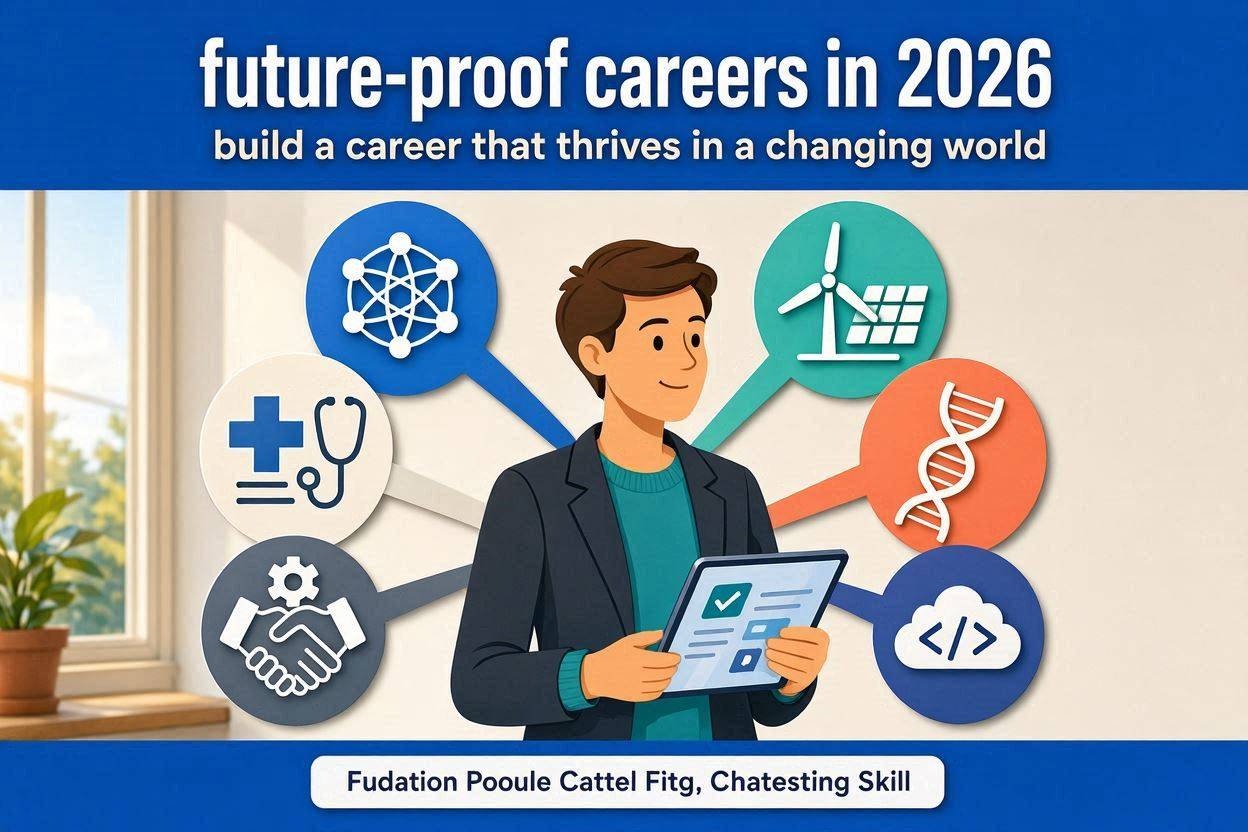
Introduction
The world of work is changing quickly. Artificial intelligence, automation, cloud technology, cybersecurity, demographic changes, and the transition toward cleaner energy are influencing the skills employers need.
For someone choosing a first career or considering a professional change, this creates both challenges and opportunities. Some routine tasks may become automated, while new roles are emerging around technology, healthcare, infrastructure, data, and human-centered services.
Rather than looking for a career that can never be affected by technology, it is more practical to choose a field where human expertise, technical knowledge, judgment, creativity, or hands-on skills continue to provide value.
This guide looks at career areas that may remain important in 2026 and beyond, the skills associated with them, and practical ways to prepare for a changing job market.
What Does "Future-Proof Career" Actually Mean?
A future-proof career does not mean a job that is guaranteed to exist forever. No profession can offer that guarantee.
Instead, the term generally describes a career that has characteristics such as:
- Continued demand from employers or consumers
- Opportunities to develop new skills
- Responsibilities that are difficult to automate completely
- Multiple paths for specialization
- Transferable skills that can be used in different industries
- Potential for professional growth
The strongest career choices are often those where technology becomes a tool that helps professionals work more effectively rather than simply replacing the entire role.
Why Career Planning Matters More Than Ever
Technology can change the responsibilities associated with a job without eliminating the profession itself. For example, software developers now use AI-assisted tools, marketers rely heavily on analytics, and healthcare workers increasingly use digital systems.
This means career planning should focus not only on the job title but also on the skills behind the job.
Developing adaptable skills can help professionals:
- Respond to changes in their industry
- Qualify for new opportunities
- Work with emerging technologies
- Move between related roles
- Compete for remote and international positions
- Continue learning throughout their careers
1. Artificial Intelligence and Machine Learning
Artificial intelligence has become one of the most influential areas of modern technology. Organizations are exploring AI for customer service, software development, research, healthcare, finance, manufacturing, education, and business operations.
AI-related roles can include machine learning engineers, AI developers, research specialists, data professionals, and AI implementation specialists.
Useful Skills
Professionals interested in this field may benefit from learning:
- Python and other programming languages
- Machine learning fundamentals
- Statistics and data analysis
- Model evaluation
- Data preparation
- Cloud-based AI services
- Responsible AI practices
AI is a rapidly changing field, so learning should not stop after completing one course or certification.
2. Cybersecurity
As organizations become more dependent on digital systems, protecting information and infrastructure becomes increasingly important.
Cybersecurity professionals help identify vulnerabilities, monitor systems, investigate suspicious activity, and develop security controls.
Possible career paths include security analysts, penetration testing professionals, security engineers, incident response specialists, and security administrators.
Skills to Develop
A strong foundation may include:
- Networking
- Operating systems
- Security fundamentals
- Risk management
- Threat analysis
- Identity and access management
- Security monitoring
Cybersecurity is also relevant outside the technology sector because banks, hospitals, government organizations, retailers, and manufacturers all depend on secure information systems.
3. Data and Analytics
Companies collect enormous amounts of information, but raw data has limited value unless people can understand and use it.
Data analysts, data scientists, business intelligence specialists, and related professionals help organizations identify patterns, measure performance, and make evidence-based decisions.
Important Skills
Depending on the role, useful skills can include:
- Statistics
- Spreadsheet analysis
- SQL
- Data visualization
- Python or another programming language
- Business analysis
- Communication
A successful data professional needs more than technical ability. They also need to explain findings clearly enough for non-technical decision-makers to understand.
4. Software Development
Software is now part of almost every modern business. Websites, mobile applications, payment systems, business platforms, cloud services, and internal tools all require software.
Developers may specialize in areas such as:
- Web development
- Mobile applications
- Backend development
- Full-stack development
- Cloud applications
- DevOps
- Enterprise software
AI coding tools are changing how developers work, but understanding software architecture, security, testing, debugging, and business requirements remains valuable.
Learning how to use new development tools effectively may therefore become just as important as learning individual programming languages.
5. Healthcare and Medical Services
Healthcare is one of the areas where human expertise remains particularly important. Patients need diagnosis, treatment, rehabilitation, monitoring, communication, and emotional support.
Potential careers include:
- Nurses
- Physicians
- Pharmacists
- Physiotherapists
- Medical laboratory professionals
- Radiology professionals
- Healthcare administrators
The exact requirements, salaries, and licensing rules vary significantly by country and profession.
Healthcare workers also increasingly interact with digital records, diagnostic technology, telemedicine platforms, and other tools, making digital skills useful alongside medical knowledge.
6. Renewable Energy and Energy Technology
The energy sector is evolving as countries and businesses invest in renewable generation, energy storage, efficiency, and modern electrical infrastructure.
Career opportunities may include solar installation and maintenance, wind-energy operations, battery technology, electrical work, energy management, environmental services, and engineering.
Useful Skills
Depending on the position, workers may need:
- Electrical knowledge
- Equipment maintenance
- Safety procedures
- Technical troubleshooting
- Project management
- Environmental awareness
Hands-on technical roles can be particularly valuable because many physical installation and maintenance tasks require workers to operate in real-world environments.
7. Digital Marketing and E-Commerce
Businesses increasingly use websites, search engines, social media, email, online advertising, and digital marketplaces to reach customers.
Digital marketing therefore covers much more than posting on social media.
Professionals may work in:
- SEO
- Content strategy
- Email marketing
- Social media
- Paid advertising
- Marketing analytics
- Conversion optimization
- E-commerce
The most valuable marketers are often those who can connect marketing activity to measurable business outcomes rather than simply producing large amounts of content.
8. Cloud Computing
Many organizations have moved important systems and services to cloud infrastructure. This has created demand for professionals who understand how cloud environments are designed, managed, secured, and optimized.
Major cloud ecosystems include AWS, Microsoft Azure, and Google Cloud.
Cloud-related roles can involve:
- Infrastructure
- Cloud security
- DevOps
- Systems administration
- Cloud architecture
- Application deployment
People entering this field should understand networking, operating systems, security, and basic programming in addition to learning a specific cloud platform.
9. Robotics and Automation
Automation is being used in manufacturing, logistics, warehouses, agriculture, healthcare, and other environments.
Robotics professionals may install equipment, maintain machines, diagnose faults, program systems, or improve automated processes.
This field can suit people who enjoy combining mechanical, electrical, and software concepts.
Relevant Skills
Depending on the position, useful areas include:
- Robotics fundamentals
- Electronics
- Mechanical systems
- Industrial automation
- Programming
- Equipment maintenance
- Troubleshooting
Automation does not simply eliminate work; it can also create demand for people who design, operate, maintain, and improve automated systems.
10. Skilled Trades
Skilled trades remain important because many tasks require physical presence, practical judgment, and specialized hands-on knowledge.
Examples include:
- Electricians
- Plumbers
- HVAC technicians
- Welders
- Automotive technicians
- Industrial maintenance professionals
These careers can offer an alternative to traditional university education. Depending on the trade and location, workers may enter through apprenticeships, vocational education, technical training, or industry certifications.
Experienced tradespeople may also have opportunities to operate their own businesses.
Skills That Can Remain Valuable Across Industries
Instead of depending entirely on one technical skill, professionals can build a combination of technical and human capabilities.
Technical Skills
Examples include:
- Digital literacy
- Data analysis
- AI tools
- Cybersecurity fundamentals
- Cloud technology
- Automation
- Project management
- Industry-specific software
Human Skills
Technology cannot replace every aspect of professional work. Skills such as these remain valuable:
- Critical thinking
- Communication
- Creativity
- Leadership
- Collaboration
- Adaptability
- Decision-making
- Problem-solving
- Emotional intelligence
The combination can be especially powerful. A professional who understands technology and can also communicate effectively may be able to contribute in ways that a purely technical or purely interpersonal skill set cannot.
How to Prepare for a Future-Proof Career
You do not need to learn everything at once. A more practical approach is to build skills progressively.
1. Choose a Broad Career Direction
Start by identifying an industry that matches your interests and abilities. Technology, healthcare, energy, finance, education, and skilled trades all have different requirements.
2. Research Real Job Requirements
Look at current job advertisements for the type of position you want. Pay attention to the qualifications, software, certifications, and experience employers repeatedly mention.
3. Learn One Skill at a Time
Instead of collecting dozens of certificates without practical experience, choose a useful skill and become comfortable applying it.
4. Build Practical Experience
Projects, internships, freelance work, volunteering, apprenticeships, and personal experiments can help demonstrate what you can actually do.
5. Create a Portfolio
A portfolio can be particularly useful for technology, design, marketing, writing, and other project-based careers. Show specific examples of your work rather than simply listing skills.
6. Continue Learning
A qualification can help you enter a field, but continued learning is important when technology and employer expectations change.
Industries to Watch Beyond 2026
Several sectors may continue to receive significant attention as technology and society evolve:
- Artificial intelligence
- Cybersecurity
- Healthcare
- Renewable energy
- Cloud computing
- Financial technology
- E-commerce
- Advanced manufacturing
- Biotechnology
- Education technology
Growth does not mean every job in these industries will be easy to obtain. Competition can still be high, and employers may prefer candidates with practical experience and specialized knowledge.
How to Build Long-Term Career Resilience
Career resilience comes from being prepared for change.
Professionals can improve their resilience by:
- Regularly updating their skills
- Learning how new technologies affect their industry
- Developing professional relationships
- Keeping their resume and portfolio current
- Improving communication abilities
- Taking on new responsibilities
- Exploring related career paths
- Staying open to new ways of working
The goal is not to predict exactly what the job market will look like several years from now. The goal is to become capable of adapting when it changes.
Frequently Asked Questions
What is the best future-proof career in 2026?
There is no universal best career. AI, cybersecurity, software development, healthcare, cloud computing, renewable energy, and skilled trades can all offer different opportunities. The right choice depends on your interests, education, location, experience, and long-term goals.
Can AI completely replace future-proof careers?
No career can be guaranteed to remain unchanged. AI may automate some tasks within almost any profession. Careers that involve judgment, creativity, human relationships, physical environments, or complex decision-making may be more resistant to complete automation, but they can still change.
Do I need a university degree for a future-proof career?
Not necessarily. Some careers require university education or professional licensing, particularly in areas such as medicine and certain engineering roles. Other opportunities can be accessed through vocational education, apprenticeships, professional certifications, or demonstrated practical skills.
Which skills should I learn first?
Start with skills that are relevant to your chosen career. Basic digital literacy, communication, problem-solving, and adaptability are useful almost everywhere. After that, develop specialized skills that employers in your target field actually request.
Is a high salary the best reason to choose a career?
Not always. Salary is important, but working conditions, career progression, location, education costs, job stability, personal interests, and opportunities for advancement should also be considered.